Vertical or horizontal drone video?
← All guides
Damir Pišćetek, licensed drone pilot
SKY STUDIO by Luminus Visual Studio
Published

Drone footage for websites, YouTube and property portals is shot horizontally, and for Instagram Reels and TikTok vertically. With drones there's one more difference: some drones have a true vertical mode and rotate the camera by 90 degrees, while others simply crop the vertical frame out of the horizontal one. The DJI Mavic 4 Pro has a true vertical mode, and the DJI Avata 2 FPV drone doesn't.
In short: if you only need video for Reels and TikTok, I shoot in true vertical mode on the Mavic 4 Pro. If you need both formats, or aren't sure yet, I shoot horizontally in high resolution and plan the shots so the main subject also fits in a vertical crop. With FPV filming on the Avata 2, the vertical version is always cropped in the edit.
Clients rarely think about format in advance - most often I'm the one who raises it when we're planning the shoot. A short explanation usually follows of what each format means and where it's used, and it's not unusual for a client to change their mind after the first decision and switch format before the shoot. That's why I explain it all in one place here - and why I most often suggest a solution that keeps both formats open. One client, for example, needed vertical aerial footage for a website optimised primarily for mobile phones, and for Instagram.
Aspect ratios and recommended formats
The aspect ratio tells you how wide the frame is in relation to its height. The first number is the width, the second the height: 16:9 is a horizontal frame, and 9:16 is the same frame turned vertically.
| Where it's used | Recommended format | What to watch for |
|---|---|---|
| Website and YouTube | Horizontal 16:9 | On mobile, a website can show a vertical version of the hero video. |
| Property portals, Booking, Airbnb | Horizontal photos | Galleries are displayed in landscape. |
| Reels and Stories 9:16 (1080 x 1920 px), photos 4:5 or 3:4 | On the profile grid, posts are shown as vertical 3:4 rectangles, so the main subject should be in the centre. | |
| TikTok and YouTube Shorts | Vertical 9:16 (1080 x 1920 px) | Don't place text and important details along the bottom and right edges, because the app's buttons cover them. |
| Horizontal 16:9, and short clips 9:16 | Longer video goes horizontal, short clips vertical. | |
| Projection, TV, presentations | Horizontal 16:9 | On a big screen, vertical video is left as a narrow strip. |
True vertical mode or a crop - what's the difference
A drone's camera has a landscape-oriented sensor, like any camera. A drone with a true vertical mode rotates the camera on the gimbal by 90 degrees, so the vertical frame uses the whole sensor - full resolution, full quality. A drone without it crops the vertical frame out of the horizontal one: roughly a third of the frame's width is left, and with it a lower resolution.
| Drone | Vertical shooting | What that means |
|---|---|---|
| DJI Mavic 4 Pro | True vertical mode | The camera rotates by 90°, giving a vertical frame at full quality. This is a drone I shoot with. |
| DJI Avata 2 (FPV) | None - crop only | The single-axis gimbal only tilts up and down. The vertical version is cropped in the edit. This is a drone I shoot with. |
| DJI Mini 4 Pro and Mini 5 Pro | True vertical mode | Small drones with a rotating camera, popular for social media. |
| DJI Air 3 and Air 3S | Crop | Vertical video is produced by cropping the frame, at a lower resolution. |
DJI Mavic 4 Pro - a true vertical frame
The Mavic 4 Pro has a gimbal that rotates the camera, so it shoots vertical video without cropping, in 4K (2160 x 3840) and at the full quality of the large sensor. When the camera is rotated, some of the intelligent flight modes, such as automatic subject tracking and point-of-interest orbits, work in a limited way. That isn't a problem for manually flown shots, but it does affect how the shoot is planned.
6K and a large sensor - more room to crop
When both formats are needed, I shoot horizontally in 6K with the Mavic 4 Pro. That's the highest resolution in DJI's Mini, Air and Mavic series, and most drones record 4K at most. The difference shows best in the vertical crop:
| Horizontal video | Vertical 9:16 crop | Compared with Reels/TikTok (1080 x 1920) |
|---|---|---|
| 6K (6016 x 3384) - Mavic 4 Pro | around 1900 x 3384 | around 3 times more pixels than needed |
| 4K (3840 x 2160) - most drones | around 1215 x 2160 | only just above what's needed |
More pixels also means more freedom in the edit: the crop can be shifted and the shot pushed in slightly without any visible loss of sharpness. The main camera also has a large 4/3 sensor, which gives a cleaner image with more detail and better dynamic range in difficult light. So even a cropped vertical frame holds its quality, rather than looking like an enlarged cut-out.
The same goes for photos. A 100 MP photo measures 12288 x 8192 pixels, so a vertical 4:5 crop for Instagram still has more than 50 MP.
DJI Avata 2 - vertical by cropping only
The Avata 2 is an FPV drone for fly-throughs of interiors and industrial units and for dynamic shots close to a building (more in the guide Mavic 4 Pro or Avata 2). It has no true vertical mode, so the vertical version is always cropped in the edit. Two things help:
- Shooting in 4:3. The Avata 2 also records 4K in a 4:3 ratio (3840 x 2880). The frame is taller than in 16:9, so the vertical crop has about a third more height and resolution.
- Flying straight ahead. In a narrow vertical frame, fast sideways moves and rolls quickly push the subject out of shot. A straight fly-through of a door, corridor or hall looks good in both formats.
The Avata 2's ultra-wide lens has one advantage too: a vertical crop from the centre of the frame has less distortion than the edges of the wide frame.
What a vertical crop from a horizontal frame looks like
When a horizontal frame is cut down to a vertical one, only a narrow part is left - roughly a third of the width, usually the centre. About two thirds of the frame is lost. This is how it looks on real drone footage:
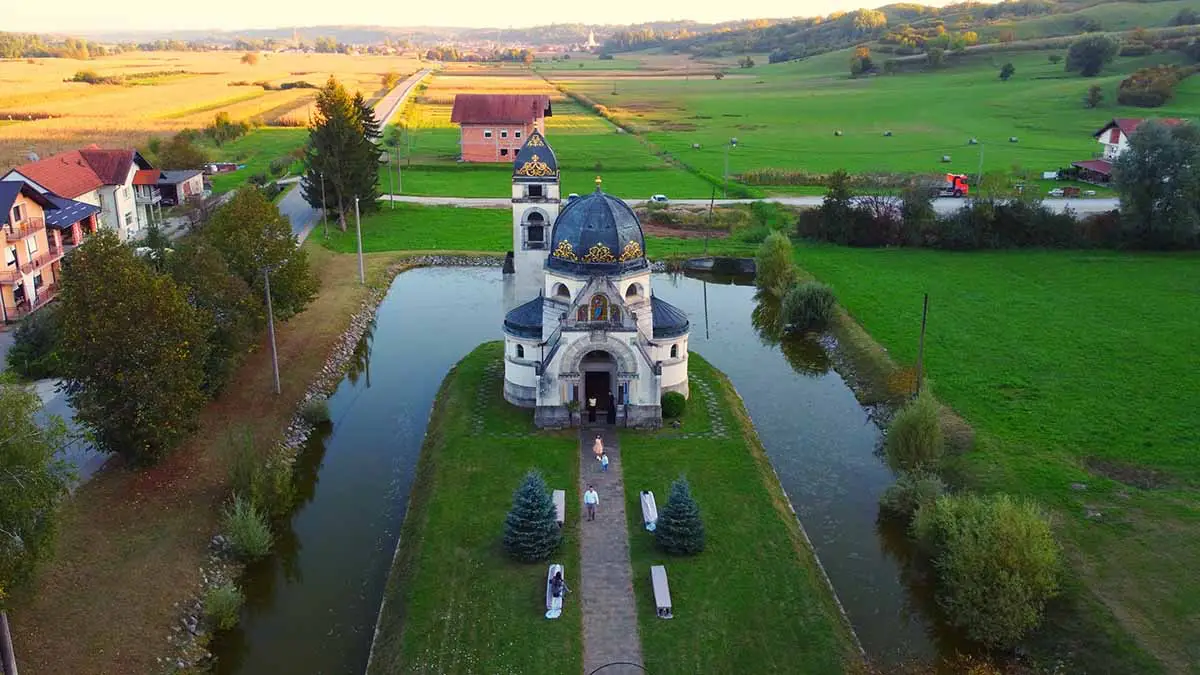 16:9 original
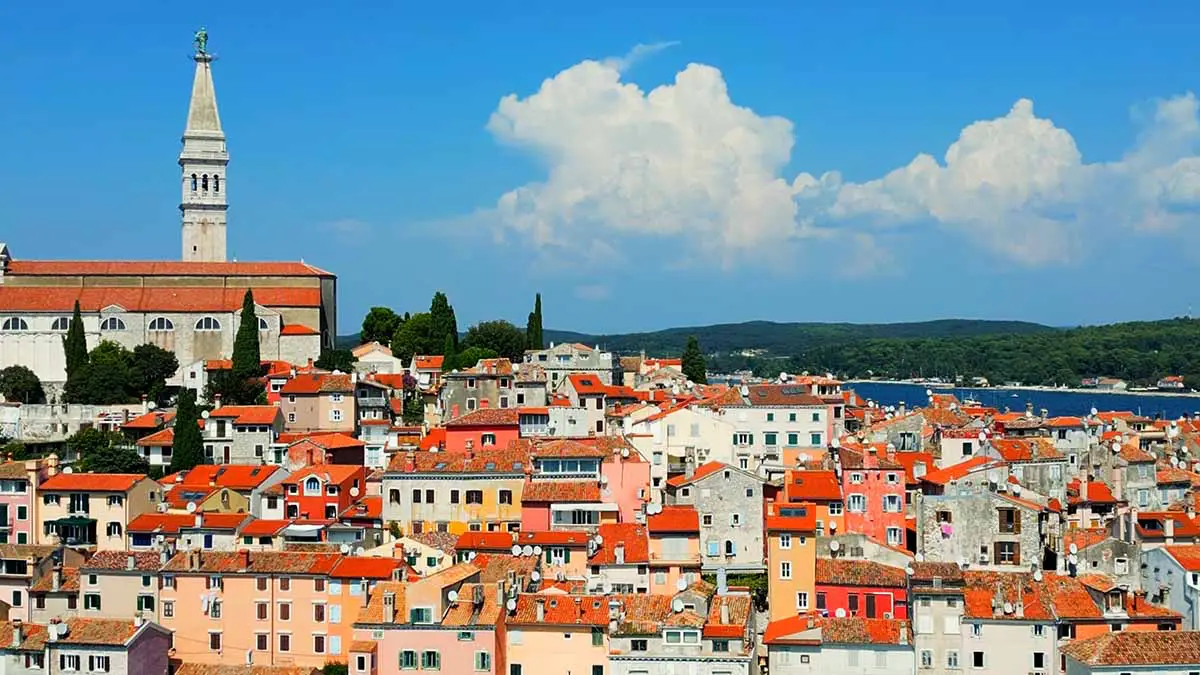 16:9 original16:9 - shifted crop
The lesson is simple: if the main subject is in the centre of the frame, a crop is enough. If it's at the edge, or the width of the view matters, the vertical version has to be planned during the flight itself - or shot in true vertical mode.
Aerial filming: which shots look good in vertical
Look good in vertical
- A rise up a tall structure - a bell tower, a building facade, a skyscraper or a chimney. Tall structures naturally fill a vertical frame.
- A top-down view - a house, pool, roof or plot shot straight down from above.
- A reveal - the drone rises from behind a roof or trees and reveals the sea, the town or the surroundings.
- An FPV fly-through straight ahead - through a door, corridor or hall, or along a facade.
Look better in horizontal
- Wide panoramas - landscape, coastline, town.
- A property's position in its surroundings - the distance to the sea, the road, neighbouring buildings.
- Sideways tracking shots and orbits around a larger site, such as a hotel, an estate or a construction site.
Vertical aerial photos
There are three ways to get vertical photos: a photo with the camera rotated on the Mavic 4 Pro, a crop from a 100 MP photo, or a vertical panorama, where several photos taken one above the other are stitched into one. A panorama works well for tall structures and for a view that can't be taken in with a single frame.
When photos or video of a property from the ground are needed alongside the aerials, I shoot them under the SPACE STUDIO brand - for more on formats for Booking, Airbnb and Instagram, see the guide horizontal or vertical photos and video for a property.
What to agree before the shoot
- Where the footage will be used - website, YouTube, property portals, Instagram, TikTok, LinkedIn, projection.
- Whether you need vertical only, horizontal only, or both. If you're not sure, say so - I'll then shoot in a way that keeps both formats open.
- How many vertical clips and how long they are.
- Whether you need vertical photos for posts, posters or roll-up banners.
- Whether the FPV drone is being used too - in that case the vertical version is a crop, so the shots are planned for it.
Permits
Format doesn't change the rules: vertical shooting is subject to the same rules as any drone filming - a registered operator, flight notification and DGU approval when required. More in the guide Drone filming permits in Croatia: what you need and who obtains it.
Frequently asked questions
Does the DJI Mavic 4 Pro have a true vertical shooting mode?
Yes. The camera rotates by 90 degrees on the gimbal, so the vertical frame uses the whole sensor and is recorded at full quality, without cropping.
Can the DJI Avata 2 shoot vertically?
The Avata 2 has no true vertical mode. It has a single-axis gimbal that only tilts up and down, so the vertical frame is cropped from the horizontal video in the edit. That's why, for a vertical version, I shoot in 4:3, which leaves more room to crop.
Can a vertical video for Reels be made from horizontal aerial footage?
Yes. A vertical 9:16 video is cropped out of the horizontal 16:9 video, but only about a third of the frame's width is left. That's why the shots are planned so the main subject also fits in a vertical crop.
Which aerial shots look best in vertical?
A rise up a tall structure (a tower, a facade, a building), a top-down view of a house or pool, a reveal from behind a roof, and an FPV fly-through straight ahead through a space. Wide panoramas and a property's position in its surroundings look better in horizontal.
Do you need a special permit for vertical drone filming?
No. The same rules apply as for any drone filming: a registered operator, flight notification and DGU approval when required. The shooting format has no bearing on that.
Need drone filming in Croatia for your website and social media?
Send the location, a rough date and where you'll use the footage, and we'll agree the formats before the shoot.
More drone filming guides
- Cinema drone or FPV drone: when the Mavic 4 Pro, and when the Avata 2When to go for smooth cinematic shots from the air, and when for an FPV fly-through of interiors and industrial units.
- Drone photography for real estate: how to prepare and what you getPreparing a house, villa or hotel, the best light and the shots that sell a property.
- How much does drone filming cost and what the price depends onWhat's included in the price and what pushes it up.